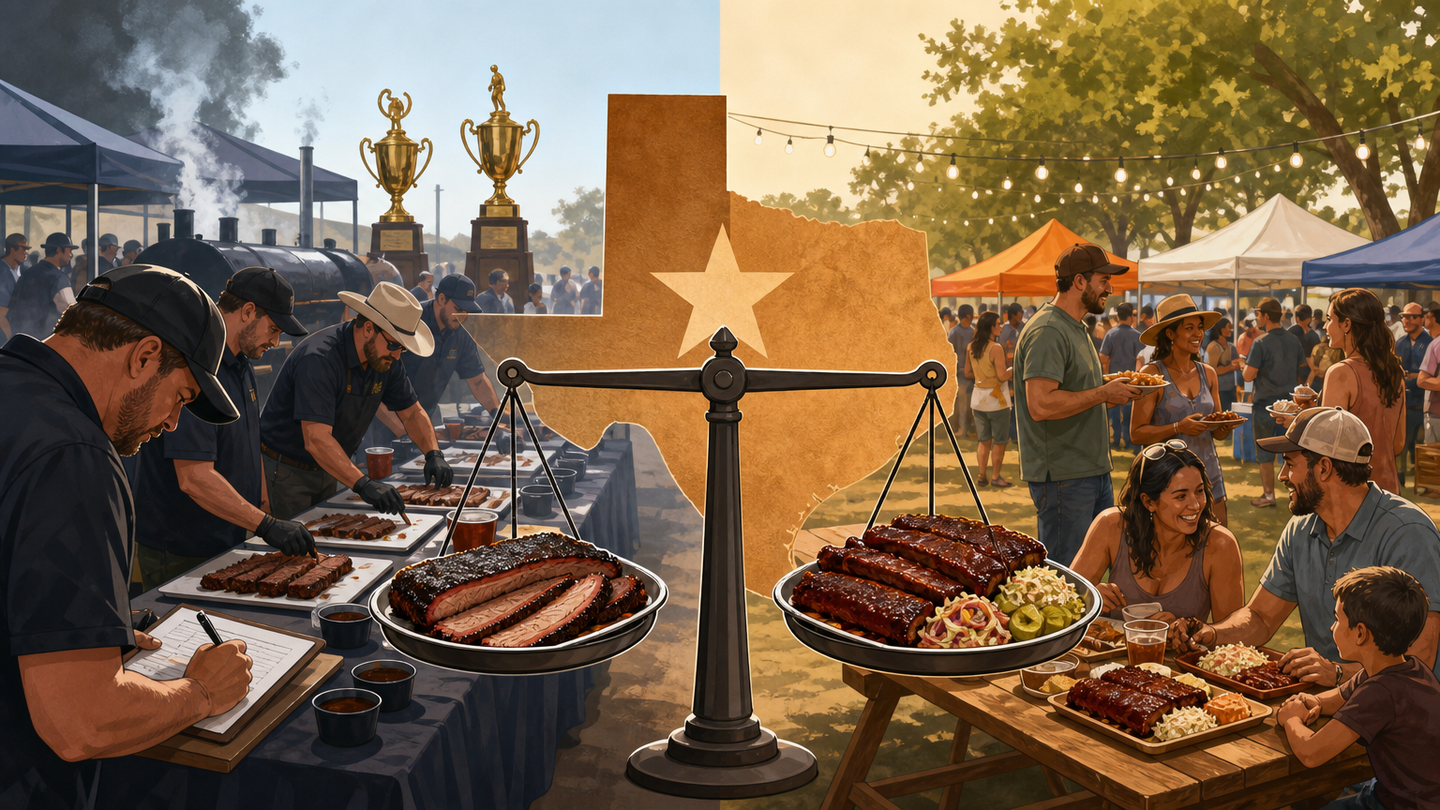
A Texas barbecue event can mean very different things depending on what is at its center. One gathering may be built around a judged cook-off, another around tasting barbecue from a group of established joints, and another around the social energy of a larger celebration. Knowing that distinction makes it easier to choose an event that fits the day you want—not merely one with barbecue in its name.
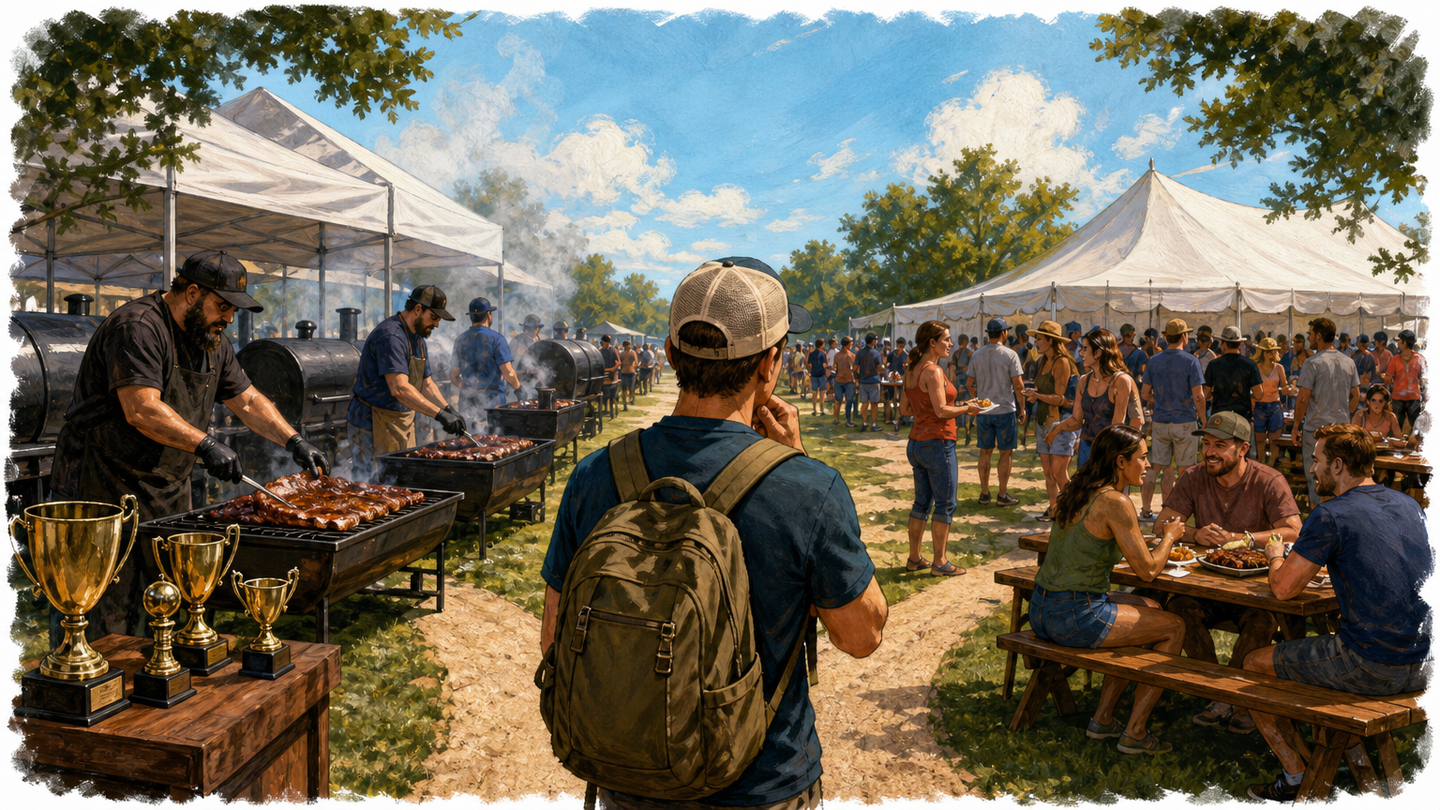
Two useful reference points show the range. The World’s Championship Bar-B-Que Contest, presented by the Houston Livestock Show and Rodeo, is an invitation-only competition with designated public venues for visitors. BBQ Fest in Lockhart, a Texas Monthly live event, has included a Top 50 Picnic format featuring barbecue joints from across Texas. Both belong in a Texas barbecue calendar, but they reward different kinds of visitors.
Defining the Alternatives
Competition-centered cook-offs
A cook-off is organized around teams competing in barbecue categories. The food, equipment, team spaces, judging, and contest rules shape the event’s identity. For a visitor, the appeal is often the chance to see barbecue as a craft performed in public: smoke rising from pits, teams working through service and presentation, and a setting with a strong communal rhythm.
The World’s Championship Bar-B-Que Contest illustrates an important distinction within this category. Its competition is invitation-only, so the event should not be viewed as an open field of teams that every visitor can freely enter or sample. Public venues are identified for guests, giving visitors a defined way to participate while the contest itself retains its competitive structure.
Choose a competition-centered event when the atmosphere, the tradition of the cook-off, and the spectacle of teams at work matter as much as tasting a broad selection of barbecue. It is particularly suited to someone who enjoys the social side of barbecue culture and does not expect every cooking area to function like a public tasting station.
Tasting-centered barbecue festivals
A tasting festival puts the visitor’s eating experience closer to the foreground. Rather than asking guests to navigate a competition environment, it gathers participating barbecue businesses or cooks into a shared festival format. The earlier BBQ Fest program’s Top 50 Picnic is a clear example: barbecue joints from across Texas were part of the occasion.
This format is a strong fit for a diner whose main goal is comparison. The practical pleasure is moving from one style, pit, or restaurant approach to another and forming a personal opinion about what stands out. A visitor may care about brisket at one stop, sausages at another, or the contrast between familiar regional traditions and something less expected.
A festival lineup can change from one edition to another, so the concept matters more than assumptions about any single participant. Think of this option as a barbecue tasting occasion first and a broader event second.
Meaningful Differences to Compare
The most useful comparison is not “Which event is better?” It is “What kind of barbecue day do I want?” Start with the event’s primary purpose.
At a competition, barbecue is both food and performance. Teams are pursuing results within a contest, and visitor access may be shaped by the event’s public areas and policies. The experience can feel immersive because the work of cooking is part of what you are there to see.
At a tasting festival, barbecue is more directly the object of discovery. The value comes from range: multiple participating joints, multiple approaches, and the opportunity to notice differences side by side. A format such as the Top 50 Picnic encourages a broad view of Texas barbecue rather than attention on a single team or pit.
Scale is another meaningful difference, but it should not be mistaken for quality. A large event can offer a powerful sense of occasion, while a more concentrated tasting format can make food comparison feel like the central activity. Neither approach automatically produces a better visit. The right choice depends on whether you want an event you happen to eat at or an eating experience presented as an event.
Access also deserves careful attention. “Public” does not always mean that all parts of an event work the same way. The Houston contest’s invitation-only structure, paired with designated public venues, is a reminder to distinguish between attending an event and entering each team’s space. That distinction can shape expectations before you arrive.
Practical Tradeoffs
A competition setting may reward a relaxed approach. There can be plenty to absorb beyond a plate of barbecue: team identity, the pace of pit work, and the feeling of being surrounded by a major cook-off. In return, a visitor should be comfortable with the fact that access and food availability can be structured differently from a tasting festival.
A tasting-focused gathering makes more sense when your priority is deliberate sampling. It is easier to turn the day into a personal barbecue survey: try smaller portions where possible, share tastes with companions, and pay attention to contrasts instead of filling up immediately. The tradeoff is that the contest element may be less central, or absent altogether.
Your group changes the equation as well. A barbecue enthusiast who wants to talk pits and observe teams may gravitate toward a cook-off. Friends who want to compare several respected barbecue stops may prefer the tasting-festival model. For a mixed group, decide whether the day’s anchor is social spectacle or focused eating; that simple choice prevents mismatched expectations.
Avoid treating a famous event name as a guarantee of a particular experience. A title may emphasize championship competition, while a program may emphasize a shared meal among participating joints. Read the event description for the activity it actually highlights: teams and contest structure, participating restaurants, designated public spaces, or a named tasting program.
Making the Decision
Pick a competition-centered event if you want barbecue culture in motion. The Houston contest is a useful model for this choice: it is tied to a major rodeo organization, organized as an invitation-only contest, and provides identified public venues for visitors. Go with the expectation that you are attending a competition environment rather than a simple all-purpose barbecue tasting.
Choose a festival built around participating barbecue joints if the goal is to taste across Texas in one setting. BBQ Fest in Lockhart is the useful model here, especially given its prior Top 50 Picnic format. This is the better match for a visitor who wants to make comparisons plate by plate and come away with a broader sense of different barbecue approaches.
When both sound appealing, let your priority break the tie. Choose smoke, teams, and contest-pageantry for the cook-off experience. Choose variety, direct tasting, and side-by-side food exploration for the festival experience. Texas barbecue is large enough to hold both traditions, and each reveals a different side of why people gather around a pit.
Confirm the current visitor policies, participating venues, and program details with the event’s official information before making plans. The best Texas barbecue event for you is the one whose format matches the experience you actually want: competition spectacle, a wide tasting opportunity, or a little of each.
Information may contain errors, omissions, or outdated details. Confirm time-sensitive information with the relevant official or authoritative source.